
Skip to content
24/7 coordination: 0333 006 2393
Care Circle Ltd — The Reliable Care Agency

Nurse-led community care

Tracheostomy Care

Airway observation, tracheostomy care and suction where assessed and authorised.

Individual tracheostomy support at home, delivered to an agreed clinical plan by professionals whose competency has been assessed for the person’s needs and equipment.

  • Nurse-led assessment
  • Competency-assessed professionals
  • Scope and availability confirmed before care
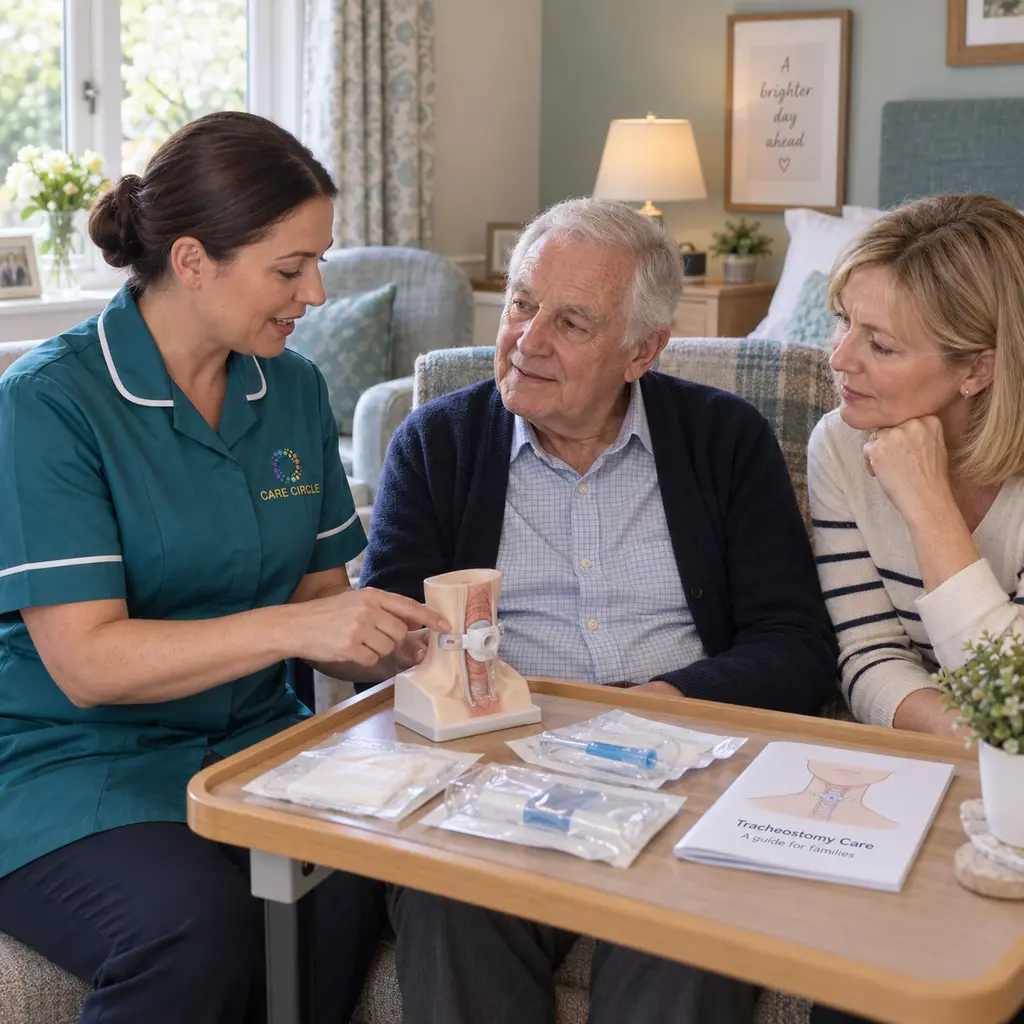
A Care Circle nurse discussing a tracheostomy teaching model with an older man and his relative.

Tracheostomy support: understanding the care plan

Where support may involve Treatment of Disease, Disorder or Injury, the activity is not accepted automatically. Delivery depends on individual assessment, professional authorisation, competency, Care Circle Ltd’s verified registered scope and suitable staffing.

Understanding the service

What tracheostomy care means in practice

Tracheostomy support helps a person live at home with an artificial airway. The airway needs regular observation, careful stoma-site care, humidification and secretion management, and an emergency plan that everyone around the person understands. Care follows the clinical plan written by the responsible ENT, respiratory or specialist tracheostomy service.

Who this service may help

Support shaped around the person, not the condition alone.

Support is frequently arranged as part of a discharge home, once an airway plan is established and stable. It may also help where a family has been managing airway care alone and needs trained overnight cover or respite, or where a commissioner is arranging an assessed complex-care package around a long-term tracheostomy.

Suitability depends on the complete picture rather than a diagnosis or a requested intervention alone. The circumstances below are the ones people most often describe when they contact Care Circle about this service.

  • Adults living with a long-term or temporary tracheostomy
  • People preparing for discharge home with an established airway plan
  • Families requiring trained support, respite or overnight care
  • Commissioners arranging an assessed complex-care package

What Care Circle can provide

What this service can include

Support can include airway and breathing observation, routine tracheostomy and stoma-site care, humidification, secretion management, suction where clinically authorised, checks of emergency equipment such as spare tubes and suction supplies, and the personal and daily-living care that sits alongside the clinical routine.

Nothing below is offered automatically. Each element is included only where the assessment, written clinical instructions and Care Circle’s registered scope support it, and where a professional assessed as competent for that task is available.

  • Airway and breathing observations
  • Routine tracheostomy and stoma-site care
  • Suction where clinically authorised
  • Humidification and secretion-management support
  • Equipment and emergency-kit checks
  • Recording, escalation and emergency protocols
  • Personal care and daily-living support alongside clinical needs

How the service is planned

A coordinated plan before care begins

Assessment confirms the tube type and size, cuff arrangements, cleaning and change responsibilities, suction authorisation, humidification requirements, emergency supplies and who to contact in a crisis. Staff are then trained and competency-assessed on that specific airway before any shift is covered, and the plan is reviewed if the tube or routine changes.

  1. 1An initial conversation or professional referral to understand the requested support
  2. 2A detailed assessment of clinical needs, daily routines, risks, goals and the home environment
  3. 3Review of current instructions, prescriptions, equipment and relevant professional plans
  4. 4A written care plan, risk assessments and escalation arrangements agreed before care begins
  5. 5Regular review, with changes made through the appropriate clinical or commissioning process

Working with the wider team

Care is coordinated, with consent, with the person, family, GP, ENT or respiratory consultant, speech and language therapist, dietitian, specialist tracheostomy team, hospital and commissioner as relevant.

The professionals involved

Who delivers the service, and how competence is considered

Care is overseen by a registered nurse and delivered by staff assessed as competent for this person's airway and emergency procedures. Suction, inner-cannula care and similar tasks are undertaken only where authorised in the plan and signed off individually. Family members may continue with the routines they prefer to keep.

Competence is specific

A qualification or registration does not authorise every task. Care Circle matches professionals to the interventions written into the plan, and reassesses when needs, equipment or instructions change.

Safety, monitoring and escalation

Competency, oversight and clear escalation

The plan sets out the recognition and response to obstruction, tube displacement, bleeding, infection and respiratory deterioration, including when 999 must be called. Observations and any concern are recorded and escalated to the specialist team. Emergency equipment is checked and its availability documented.

  • Support is delivered only within Care Circle’s registered scope and the professional’s role
  • Professionals are selected for relevant training, experience and assessed competency
  • Clinical instructions, recording requirements and escalation thresholds are set out in the care plan
  • Competency and care arrangements are reviewed when needs, equipment or prescribed treatment change
  • Competency is assessed using the person’s tracheostomy type, equipment and emergency procedures
  • The plan identifies obstruction, displacement, bleeding, infection and respiratory deterioration responses

Frequently asked questions

Questions about tracheostomy care

Next step

Start with a careful conversation

Following a referral or enquiry, Care Circle reviews the airway plan, competency requirements and staffing before responding. Where support can be considered, training and sign-off are arranged in advance of the first shift. Service availability is subject to individual assessment, Care Circle’s registered scope, professional authorisation where required, and the availability of appropriately trained and competency-assessed professionals.