The person’s story and routines
Work, family, culture, faith, music, food, daily habits and preferred words help the team understand the person beyond a diagnosis.

Dementia care at home
A home holds more than belongings. It holds routines, relationships, identity and years of memories.
Care Circle provides assessment-led support for people living with dementia who want to remain in familiar surroundings for as long as home continues to be a safe and suitable place for them.
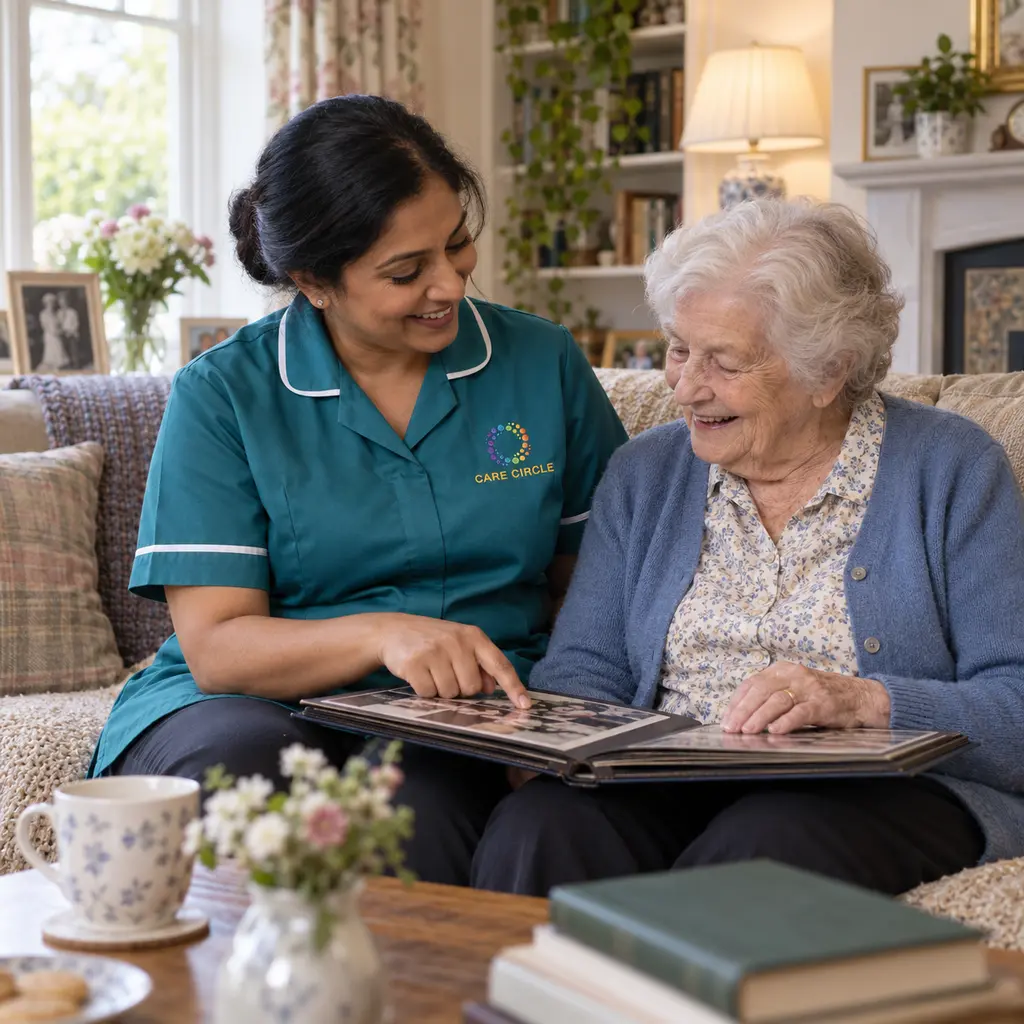
Familiar moments and patient, personal support
Why home matters
Home care is not automatically right for every person or every stage of dementia. When it is suitable, it can protect continuity while the right support is brought around the person.
A particular chair, the view from a window, the route to the kitchen and the rhythm of a morning can carry meaning long after other details become difficult to place. Remaining at home can preserve cues that help a person understand where they are and how the day normally unfolds.
The NHS explains that many people with mild-to-moderate dementia can stay in their own home and live well when they have adequate support, and that familiar surroundings can help them cope better. That does not mean leaving a family to manage alone. It means building enough practical care, observation, respite and professional coordination around the life already there.
Care Circle starts with the person’s wishes and abilities, then considers the home, family capacity, health needs and foreseeable risks. The plan is reviewed because dementia is progressive and because a safe arrangement today may need more support tomorrow.
Around 1 million
Alzheimer’s Society projects this will rise to 1.4 million by 2040.
Continuity is part of good care
NICE recommends that services maximise continuity and consistency and learn the person’s likes, dislikes, routines and personal history.
Carers need support too
NHS and NICE guidance recognise carers’ need for assessment, practical support and planned respite.
Care around the whole person
The exact support is agreed after assessment and written into the care plan. These are the areas families most often need to bring together.
Work, family, culture, faith, music, food, daily habits and preferred words help the team understand the person beyond a diagnosis.
Unhurried help with washing, dressing, continence and grooming is planned around privacy, consent, communication and the person’s usual way of doing things.
Prompts or practical support are provided only as agreed in the care plan, with changes or concerns recorded and escalated through the appropriate route.
Familiar interests, conversation, movement, time outdoors and ordinary household activities can help the person remain involved rather than having every task done for them.
The assessment considers mobility, falls, kitchen risks, leaving home, night-time needs, equipment and how to support choice without using unnecessary restriction.
With appropriate consent, families can contribute knowledge, receive agreed updates and plan reliable breaks without being displaced from the person’s life.
A considered beginning
Care is introduced through assessment, matching and shared information. A small team is kept wherever possible, with clear cover arrangements when a usual care professional is unavailable.
We learn what a usual day looks like, what matters to the person, what has changed and where the family needs support.
Needs, risks, communication, timing and compatibility inform the written plan and the small team considered for the package.
Introductions, handovers and familiar routines help care become part of the day without unnecessarily taking the day over.
Visit records, family feedback and planned reviews help the team respond when health, behaviour, sleep or independence changes.
An anonymised Care Circle story
Privacy note: James is a pseudonym. Identifying details have been changed, and this account is limited to care themes that can be shared safely.
For James, home was not a backdrop to his life. It was part of the life itself.
He had spent many years in business leadership and was used to making decisions, carrying responsibility and being known for the person he was. The country house he shared with his family had been chosen and shaped with care. His children had grown up there. Ordinary rooms held years of celebrations, conversations and quiet family routines.
When memory changes began and James was later living with early dementia, his family did not see a house that had become inconvenient. They saw the place where he felt most connected to himself. They wanted to protect that connection for as long as it remained safe, while recognising that love alone could not provide every hour of practical support.
The family came to Care Circle through a personal recommendation. The first work was not to impose a new timetable. It was to listen: how James preferred to begin the day, what made conversation comfortable, which parts of his independence mattered most, how his family communicated with him and what tended to make an unsettled moment better or worse.
A small pool of care professionals was carefully introduced. Keeping the circle small meant James could meet the same faces and hear the same reassuring approaches. The team learned his pace and preferences, while the family shared the knowledge that only years together can provide. Records and handovers kept that understanding available when a different member of the team provided cover.
Over time, care became woven into daily life rather than sitting outside it. The professionals remained accountable carers—with care plans, boundaries, safeguarding and clear responsibilities—but they were also people James recognised and his family trusted. Decisions and concerns could be discussed within one connected circle: James, his family and the team around him.
That trust gave his family something essential: permission to pause. They could rest or travel knowing that support had not been handed to strangers with only a list of tasks. It had been entrusted to a familiar team who understood the person, the home and the plan for responding if anything changed.
Dementia did not disappear, and Care Circle would never suggest that care can cure it. As James’s needs developed, the work was to keep learning—reviewing the plan, adjusting support and noticing what his behaviour or communication might be expressing. The measure of good care was not a perfect day. It was whether James could continue to feel safe, respected and known in the place that meant home to him.
A circle of care is strongest when professional skill and family knowledge meet around the person—not around the diagnosis.
Care that changes with the person
Dementia affects people differently. These are not fixed stages or promises; they show how the focus of home care may need to change over time.
Earlier support
A person may need prompts, companionship, help with appointments or support to keep doing familiar activities. The aim is to work with existing strengths, not replace them.
Increasing support
More regular visits, personal care, meal and medication support, safer routines or night care may become helpful. Continuity and calm communication become increasingly important.
More complex needs
Advanced dementia may involve mobility, swallowing, continence, communication or clinical needs. The package may need additional staff, equipment, nursing or multidisciplinary input, and home care must remain safe and appropriate.
Safety and honesty
Care Circle reviews the arrangement when there is a change in mobility, eating or drinking, continence, sleep, communication, distress, leaving home, family capacity or clinical need. More hours, night support, equipment, nursing or multidisciplinary input may be required.
Sudden confusion or a rapid change is not automatically treated as dementia progression. Pain, infection, delirium, injury or another illness may require prompt medical assessment. Care Circle is planned care and does not replace a GP, NHS 111 or emergency services.
When urgent help is needed
Call 999 for a life-threatening emergency. Contact NHS 111 or the person’s GP for urgent medical advice as appropriate. Follow the escalation plan agreed for the care package.
Local dementia support
Care Circle considers dementia-care enquiries across East of England, East Anglia, London, Cambridge, Newmarket, Cambridgeshire, Suffolk, Essex, Norfolk, Hertfordshire. Availability depends on assessment, location, the required pattern and suitably matched staff.
People may be living with Alzheimer’s disease, vascular dementia, dementia with Lewy bodies, frontotemporal dementia or more than one type. The diagnosis matters, but it does not tell us the whole person or exactly how support should feel in their home.
Support may begin with regular home-care visits and develop into longer one-to-one periods, waking nights, live-in care or planned respite. If clinical nursing is required, it is assessed separately and incorporated only where Care Circle’s registered scope, professional authorisation and staff competency support it.
The initial public enquiry form asks only for enough information to make contact. Detailed health and care information should be discussed through the protected assessment process.
Frequently asked questions
Talk to Care Circle
An enquiry does not commit you to a package. It gives our team enough context to arrange a careful conversation and explain assessment, availability and the next appropriate step.