
Skip to content
24/7 coordination: 0333 006 2393
Care Circle Ltd — The Reliable Care Agency

Nurse-led community care

Neurological and Spinal Injury Care

Coordinated support for adults living with neurological conditions, acquired brain injury or spinal injury.

Coordinated home care for adults living with neurological conditions, acquired brain injury or spinal injury, shaped around function, communication, clinical needs and personal goals.

  • Nurse-led assessment
  • Competency-assessed professionals
  • Scope and availability confirmed before care
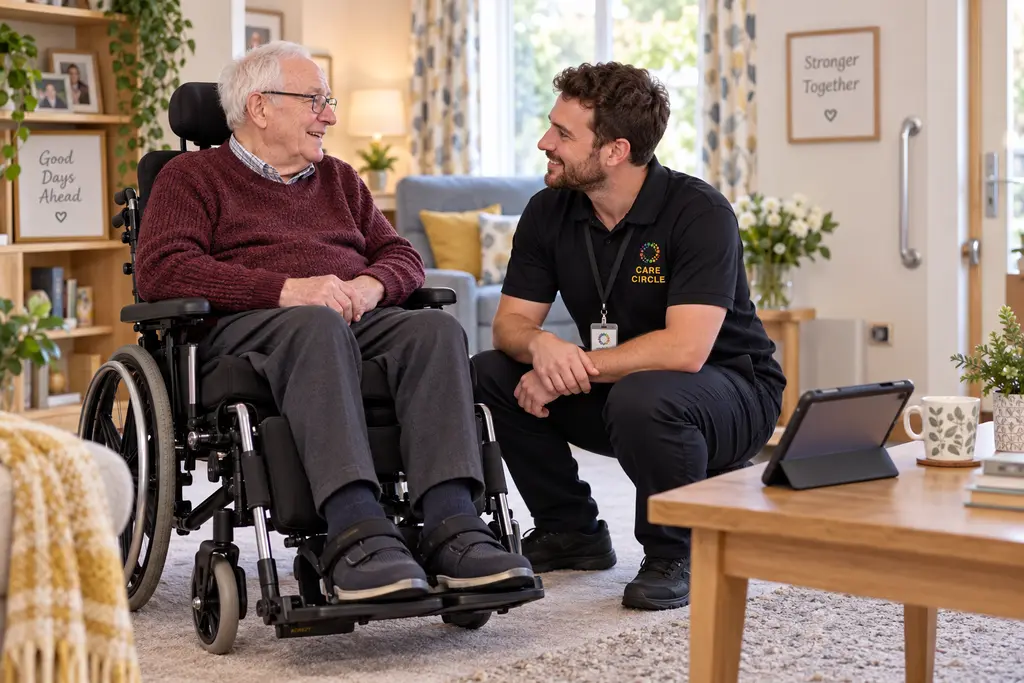
A Care Circle professional speaking at eye level with an older wheelchair user in an accessible home.

Neurological support that respects independence

Where support may involve Treatment of Disease, Disorder or Injury, the activity is not accepted automatically. Delivery depends on individual assessment, professional authorisation, competency, Care Circle Ltd’s verified registered scope and suitable staffing.

Understanding the service

What neurological and spinal injury care means in practice

Neurological and spinal injury care supports adults living with conditions such as acquired brain injury, spinal cord injury, multiple sclerosis, motor neurone disease or Parkinson's. These situations combine physical care with communication, cognition, fatigue, continence, respiratory and emotional considerations, so the package is built around the whole day rather than a list of tasks.

Who this service may help

Support shaped around the person, not the condition alone.

Packages are commonly arranged during discharge from a rehabilitation or spinal unit, when a progressive condition reaches a point where existing support is insufficient, or where a case manager is establishing long-term care following an injury settlement. Families also seek consistent, trained support to protect routines built over years.

Suitability depends on the complete picture rather than a diagnosis or a requested intervention alone. The circumstances below are the ones people most often describe when they contact Care Circle about this service.

  • Adults with an acquired brain injury or spinal cord injury
  • People living with stroke, multiple sclerosis, Parkinson’s disease or a neuromuscular condition
  • People whose neurological needs affect mobility, communication, cognition, breathing or daily routines
  • Families, case managers and commissioners developing a long-term package

What Care Circle can provide

What this service can include

Support may include personal care and safe moving and handling, positioning and pressure-area management, bladder and bowel programmes, respiratory support where assessed, medicines administration, seizure or autonomic-dysreflexia protocols where relevant, support with communication, and enabling work, study, family life and community activity.

Nothing below is offered automatically. Each element is included only where the assessment, written clinical instructions and Care Circle’s registered scope support it, and where a professional assessed as competent for that task is available.

  • One-to-one, double-up, overnight or continuous support where assessed
  • Personal care, positioning, transfers and pressure-area care
  • Support with prescribed medicines, nutrition and clinical interventions
  • Communication and cognitive support based on professional guidance
  • Support to pursue rehabilitation and community-access goals
  • Seizure, autonomic dysreflexia or other condition-specific protocols where relevant
  • Structured records, escalation and nurse-led review

How the service is planned

A coordinated plan before care begins

Assessment considers the neurological presentation, equipment such as hoists, wheelchairs, standing frames and pressure-relieving surfaces, therapy goals, cognitive and communication needs, fatigue patterns and the routines the person has established. Therapy and specialist-team instructions are built into the care plan rather than run separately.

  1. 1An initial conversation or professional referral to understand the requested support
  2. 2A detailed assessment of clinical needs, daily routines, risks, goals and the home environment
  3. 3Review of current instructions, prescriptions, equipment and relevant professional plans
  4. 4A written care plan, risk assessments and escalation arrangements agreed before care begins
  5. 5Regular review, with changes made through the appropriate clinical or commissioning process

Working with the wider team

Planning can involve the person, family, GP, neurologist, spinal or brain-injury team, therapists, pharmacy, rehabilitation service, case manager, solicitor or deputy, hospital and commissioner, according to consent and need.

The professionals involved

Who delivers the service, and how competence is considered

Packages are nurse-led where clinical intervention is involved, with support workers trained on this person's transfers, equipment, communication method and specific protocols. Physiotherapy input can be coordinated where appropriate. Continuity is prioritised because small changes in presentation are most reliably noticed by a familiar team.

Support may be arranged as scheduled visits, extended blocks, one-to-one or double-up staffing for safe handling, waking nights, sleep-ins, live-in care, continuous packages or planned respite, depending on assessed need and funding.

Competence is specific

A qualification or registration does not authorise every task. Care Circle matches professionals to the interventions written into the plan, and reassesses when needs, equipment or instructions change.

Safety, monitoring and escalation

Competency, oversight and clear escalation

Records track skin, bowel and bladder management, positioning, seizures, spasticity, mood and function. The plan sets out escalation for autonomic dysreflexia, respiratory deterioration, prolonged seizures, pressure damage and falls, including emergency thresholds and the specialist services to inform.

  • Support is delivered only within Care Circle’s registered scope and the professional’s role
  • Professionals are selected for relevant training, experience and assessed competency
  • Clinical instructions, recording requirements and escalation thresholds are set out in the care plan
  • Competency and care arrangements are reviewed when needs, equipment or prescribed treatment change
  • Condition-specific emergency and escalation plans are agreed with the relevant clinical team
  • Moving, handling, positioning and equipment use are individually assessed

Frequently asked questions

Questions about neurological and spinal injury care

Next step

Start with a careful conversation

Referrals are reviewed against clinical need, equipment, environment, funding and staffing competence. Care Circle will explain what training and coordination would be required before support could begin. Service availability is subject to individual assessment, Care Circle’s registered scope, professional authorisation where required, and the availability of appropriately trained and competency-assessed professionals.