
Skip to content
24/7 coordination: 0333 006 2393
Care Circle Ltd — The Reliable Care Agency

Nurse-led community care

Community Nursing at Home

Planned nursing visits at home for clinical observations, injections, insulin, blood sampling, wound care and other authorised interventions.

Planned nursing care at home can help a person receive specific clinical interventions, monitoring and education without unnecessary travel. Care is based on an individual nursing assessment and coordinated with the professionals already involved.

  • Nurse-led assessment
  • Competency-assessed professionals
  • Scope and availability confirmed before care
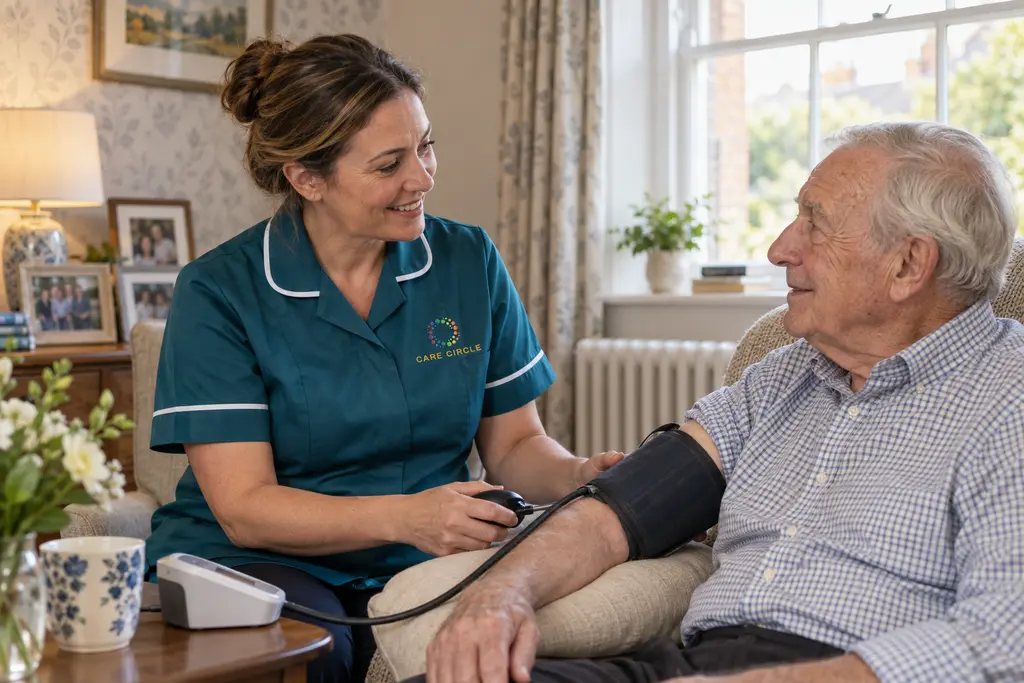
A Care Circle-uniformed nurse discussing a blood-pressure assessment with an older man in his sitting room.
Where support may involve Treatment of Disease, Disorder or Injury, the activity is not accepted automatically. Delivery depends on individual assessment, professional authorisation, competency, Care Circle Ltd’s verified registered scope and suitable staffing.

Understanding the service

What community nursing at home means in practice

Community nursing brings planned clinical care into the place a person already lives. Rather than travelling to a clinic for an observation, an injection or a dressing change, the person receives that care at home from a nurse working to written instructions. The purpose is continuity: the same recorded plan, the same escalation route and the same professionals involved in the person's wider treatment.

Who this service may help

Support shaped around the person, not the condition alone.

Families often make contact after a hospital stay, when a district nursing service cannot offer the frequency required, or when a long-term condition needs closer monitoring than a routine appointment allows. Professionals may approach Care Circle to arrange a defined episode of nursing care, such as post-operative observation, a course of prescribed injections or regular wound review at home.

Suitability depends on the complete picture rather than a diagnosis or a requested intervention alone. The circumstances below are the ones people most often describe when they contact Care Circle about this service.

  • Adults who need an assessed nursing intervention at home
  • People managing a long-term condition or prescribed treatment plan
  • People returning home after hospital treatment or surgery
  • Families who need education and reassurance about an agreed care plan
  • Professionals arranging a defined package of community nursing support

What Care Circle can provide

What this service can include

What a nursing visit contains is decided by the assessment and the written instructions available, not by request alone. A visit may include observations, administration of prescribed medicines, wound review, catheter or stoma support, blood sampling through an appropriate pathway, or teaching a family member what to watch for. Each item is recorded so the wider team can see what was done.

Nothing below is offered automatically. Each element is included only where the assessment, written clinical instructions and Care Circle’s registered scope support it, and where a professional assessed as competent for that task is available.

  • Nursing assessments, clinical observations and monitoring
  • Administration of prescribed medicines, injections or insulin where authorised
  • Diabetes support within an agreed plan
  • Venepuncture and blood sampling when requested through an appropriate clinical pathway
  • Wound assessment, dressing changes and documented escalation
  • Catheter management and stoma support
  • PEG, RIG or NG enteral-feeding support
  • Post-operative monitoring and palliative nursing support
  • Care-plan reviews, record keeping and education for the person or family

How the service is planned

A coordinated plan before care begins

Planning starts with the referral information and the current clinical instructions. Care Circle checks what is prescribed, what equipment and supplies exist, who holds clinical responsibility and what must happen if the person deteriorates. Only then are visit frequency, duration and the required nursing competencies confirmed, alongside a written care plan and risk assessment agreed before the first visit.

  1. 1An initial conversation or professional referral to understand the requested support
  2. 2A detailed assessment of clinical needs, daily routines, risks, goals and the home environment
  3. 3Review of current instructions, prescriptions, equipment and relevant professional plans
  4. 4A written care plan, risk assessments and escalation arrangements agreed before care begins
  5. 5Regular review, with changes made through the appropriate clinical or commissioning process

Working with the wider team

With consent and where relevant, the nursing team can communicate with the person, family, GP, consultant, pharmacy, community nursing team, hospital, therapist or commissioner. This supports accurate instructions, continuity and timely escalation without duplicating existing services.

The professionals involved

Who delivers the service, and how competence is considered

Visits are undertaken by registered nurses holding current NMC registration, supported by Care Circle's clinical leadership. Registration alone does not authorise every procedure: each nurse is matched to the specific interventions in the plan and must have been trained and competency-assessed for them. Where a task falls outside assessed competence, it is not undertaken and is referred back.

Competence is specific

A qualification or registration does not authorise every task. Care Circle matches professionals to the interventions written into the plan, and reassesses when needs, equipment or instructions change.

Safety, monitoring and escalation

Competency, oversight and clear escalation

Every visit is documented, including observations, medicines administered, wound or site condition and any concern raised. The care plan states the thresholds at which the nurse contacts the GP, community team, out-of-hours service or 999. Community nursing is planned care and does not replace emergency treatment, a GP consultation or NHS services.

  • Support is delivered only within Care Circle’s registered scope and the professional’s role
  • Professionals are selected for relevant training, experience and assessed competency
  • Clinical instructions, recording requirements and escalation thresholds are set out in the care plan
  • Competency and care arrangements are reviewed when needs, equipment or prescribed treatment change
  • Care Circle does not diagnose conditions or prescribe medicines through this service, and does not replace emergency, GP or NHS services

Frequently asked questions

Questions about community nursing at home

Next step

Start with a careful conversation

A professional referral or private enquiry begins a review of the request. Care Circle will confirm what information is needed, whether the interventions fall within its registered scope, and whether suitably competent nurses are available in the area before any commitment is made. Service availability is subject to individual assessment, Care Circle’s registered scope, professional authorisation where required, and the availability of appropriately trained and competency-assessed professionals.